General Creation Storytelling Talking Plush Baby Bear How Does It Work

A stuffed toy is a toy doll with an outer textile sewn from a textile and blimp with flexible material. They are known by many names, such equally plush toys, plushies, stuffed animals, and stuffies; in Britain and Australia, they may also be called soft toys or cuddly toys. The stuffed toy originated from the Steiff company of Germany in the belatedly 19th century and gained popularity following the creation of the "Teddy" carry in the U.s. in 1903, at the same fourth dimension the German language toy inventor Richard Steiff designed a similar acquit. In the 1990s, Ty Warner created Beanie Babies, a series of animals stuffed with plastic pellets that were popular every bit collector'south items.
Stuffed toys are fabricated in many different forms, but most resemble real animals (sometimes with exaggerated proportions or features), legendary creatures, cartoon characters, or inanimate objects. They tin can be commercially or home-produced from numerous materials, most normally pile textiles similar plush for the outer material and synthetic cobweb for the stuffing. Oftentimes these toys are designed for children, but stuffed toys are popular for a range of ages and uses, and have been marked past fads in pop culture that sometimes affected collectors and the value of the toys.
Description [edit]

Stuffed toy animals for sale
Blimp toys are distinguished from other toys mainly by their softness, flexibility, and resemblance to animals or fictional characters. Stuffed toys most ordinarily take the form of animals, especially bears (in the case of teddy bears), mammalian pets such as cats and dogs, and highly recognizable animals such as zebras, tigers, pandas, lizards, and elephants. Many fictional animal-similar characters from movies, Goggle box shows, books, or other entertainment forms often appear in blimp toy versions, every bit do both real and fictional humans if the individual or character is famous enough. These toys are filled with soft plush cloth.
Stuffed toys come in an assortment of different sizes, with the smallest being thumb-sized and the largest being larger than a house.[ane] [2] However, the largest somewhat ordinarily produced stuffed animals are not much bigger than a person.[ commendation needed ] Well-nigh stuffed animals are designed to be an advisable size for easy handling. They also come in a wide variety of colors and fur textures.
Stuffed toys are normally sold in stores worldwide. Vendors are ofttimes abundant at tourist attractions, airports, carnivals, fairs, downtown parks, and full general public meeting places of well-nigh any nature, particularly if there are children present.
History [edit]

The get-go stuffed toy was a felt elephant originally sold as a pincushion, created past the German Steiff company in 1880.[iii] Steiff used newly developed technology for manufacturing upholstery to make its blimp toys.[four] In 1892, the Ithaca Kitty became one of the first mass-produced stuffed animal toys in the U.s.a., which was sold as "The Tabby True cat" printed design on muslin past Arnold Print Works.[5]
The toy manufacture significantly expanded in the early 20th century. In 1903, Richard Steiff designed a soft stuffed carry that differed from earlier traditional rag dolls considering information technology was made of plush furlike fabric.[four] At the same time in the Us, Morris Michtom created the showtime teddy bear after being inspired past a drawing of President "Teddy" Roosevelt with a bear cub.[6] In 1903, the character Peter Rabbit from English writer Beatrix Potter was the first fictional character to be made into a patented stuffed toy.[vii] The popularity of stuffed toys grew, with numerous manufacturers forming in Germany, the United Kingdom,[3] and the United states of america.[4] Many people also handmade their own blimp toys. For instance, sock monkeys originated when parents turned one-time socks into toys during the Bang-up Depression.[8]
More contempo lines of stuffed animals have been created around unique concepts, similar Uglydoll, introduced in 2001, with a number of recognizable characters and overarching way.[9]
Mod plushies from Nippon are known for kawaii styles, more often than not thought of as (at least globally) starting with Sanrio'due south Hello Kitty, with many pop characters from popular media like Pikachu and Eevee from Pokemon, and characters from stationery visitor San-10 including Rilakkuma and the Sumikkogurashi characters.[10] There is besides a trend of Japanese plushies existence shaped like mochi.
Psychology [edit]
Children also as adults can grade connections with their stuffed toys, frequently sleeping or cuddling with them for comfort. They can be sentimental objects that reduce anxiety around separation, cocky-esteem, and fright of the night.[11] In 2019 about a third of British adults reported sleeping with soft toys, and almost one-half had kept their babyhood toys.[12]
Production [edit]

Stuffed toys are fabricated from a range of materials. The primeval were created from felt, velvet, or mohair and stuffed with straw, horsehair, or sawdust.[3] [xiii] Following World War 2, manufacturers began to prefer more than synthetic materials into production,[3] and in 1954, the first teddy deport made from easily washable materials was produced.[1] Modern stuffed toys are normally synthetic of outer fabrics such as plain cloth, pile textiles like costly or terrycloth, or sometimes socks. Common stuffing materials include constructed fiber, batting, cotton wool, straw, woods wool, plastic pellets, and beans. Some modern toys incorporate applied science to move and interact with the user.[14]
Manufacturers sell two main types of stuffed toys: licensed, which are toys of characters or other licensed backdrop, or bones, which take the shape of ordinary animals or other not-licensed subjects.[fourteen]
Stuffed toys can also exist homemade from numerous types of fabric or yarn. For instance, Amigurumi is a traditional Japanese type of knitted or crocheted stuffed toy typically made with an oversized head and undersized extremities to look kawaii ('cute').[15] [16]
Cultural impact, marketing, and collectors [edit]
Stuffed toys are among the nearly popular toys, particularly for children.[ citation needed ] Their uses include imaginative play, condolement objects, display or collecting, and gifts to both children and adults for occasions such every bit graduation, disease, condolences, Valentine'southward Solar day, Christmas, or birthdays. In 2018, the global market for blimp toys was estimated to exist U.s.a.$7.98 billion, with the growth in target consumers expected to drive sales upwards.[17] They are arable in many US houses.[18]
Fads [edit]
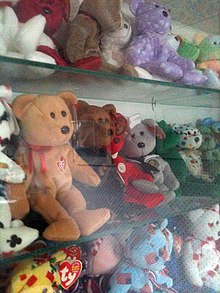
Some Beanie Babies on brandish by a collector
Many stuffed toys have go fads that have boosted the industry overall.[14] Teddy bears were an early on fad that rapidly grew into a cultural phenomenon.[4] Close to 100 years later, in the 1990s, Ty Warner created Beanie Babies, a series of animals stuffed with plastic pellets. The toys became a fad through marketing strategies that increased demand and encouraged collection.[19] [20] Pillow Pets, which can be folded from a pillow into a blimp beast, were another successful brand, launching in 2003 and selling more than than 30 million toys between 2010 and 2016.[21]
Other recent fads have involved toys paired with engineering science. Tickle Me Elmo, a laughing and shaking plush toy based on the character Elmo from the Sesame Street television bear witness, was released in 1996 and was shortly in demand, with some people buying and reselling the toy for hundreds of dollars.[22] This popularity sparked similar fads, including the robotic talking plush toy Furby released in 1998[23] and Zhu Zhu Pets, a line of robotic plush hamsters released in 2009.[24] [25]
The cyberspace also presented an opportunity for new stuffed toy fads. In 2005, Ganz launched its Webkinz stuffed toys, which each came with a dissimilar "Secret Code" that gave access to the Webkinz Earth website and a virtual version of the toy for online play.[26] [27] Webkinz's success inspired the creation of other blimp toys containing codes to unlock digital content, such as the onetime online worlds Disney'due south Club Penguin and Build-A-Bearville from Build-A-Acquit Workshop. In 2013, Disney launched its first collection of Disney Tsum Tsum stuffed toys based on characters from different Disney properties. Inspired by the popular app of the same name, Tsum Tsums were first released in Japan (an example of mochi shaped plushies) earlier expanding to the United States.[28] More recently, in 2021, Squishmallows have fabricated an appearance as a popular internet fad and collector'due south item.[29]
Meet also [edit]
- Listing of stuffed toy manufacturers
References [edit]
- ^ a b Laliberte, Marissa (2019). "11 Adorable Facts You Never Knew About Teddy Bears". Reader's Digest . Retrieved 2020-10-05 .
- ^ "Largest teddy bear". Guinness Earth Records . Retrieved 2020-10-xiv .
- ^ a b c d Soft toys. (2003). In J. Miller (Ed.), Miller's antiques encyclopedia (2d ed.). Mitchell Beazley.
- ^ a b c d Gary S. Cantankerous (1999). Kids' Stuff: Toys and the Changing World of American Childhood. Harvard University Press. pp. 93–94. ISBN9780674030077. Archived from the original on 2016-01-04.
- ^ Sachse, Gretchen (2016-07-28). "Ithaca Kitty was a success across America". The Ithaca Journal. Ithaca, New York. Retrieved 2016-08-02 .
- ^ "Teddy Bears". Library Of Congress. Archived from the original on 2009-12-05. Retrieved 2007-12-10 .
- ^ "The life of Beatrix Potter - Peter Rabbit". peterrabbit.com. Archived from the original on 2012-01-17.
- ^ Boschma, Janie (2007-xi-05). "History of the sock monkey: Blimp animate being created during the Great Depression". The Spectator. Archived from the original on 2009-12-eighteen. Retrieved 2009-07-01 .
- ^ "Toy Industry Association 2006 Award Winning Products and Nominees. List of awards". toyassociation.org . Retrieved March 22, 2019.
- ^ "San-X internet". www.san-x.jp . Retrieved 2021-12-31 .
- ^ "'My bears are my lifeline': the adults who slumber with soft toys". the Guardian. 2020-01-05. Retrieved 2021-02-02 .
- ^ "ane in 3 British adults still sleeps with a soft toy". Metro. 2019-05-xx. Retrieved 2021-02-02 .
- ^ Jaffé, Deborah (2006). The History of Toys: From Spinning Tops to Robots. Sutton Publishing. p. 155. ISBN0-7509-3850-one.
- ^ a b c Byrne, Christopher (2013). A Profile of the United states Toy Manufacture : Serious Fun. Business Good Press. pp. xiv, 62–63.
- ^ Mary Beth Temple (2009). Hooked for Life: Adventures of a Crochet Zealot . Andrews McMeel. pp. forty–41. ISBN978-0-7407-7812-4 . Retrieved 2010-03-20 .
Amigurumi.
- ^ Mary Belton (2006). Craft, Book one: Transforming Traditional Crafts. O'Reilly Media. pp. 41–42. ISBN978-0-596-52928-four. Archived from the original on 2017-12-28. Retrieved 2010-03-xx .
- ^ "Stuffed Animal & Plush Toys Market Size, Share - Manufacture Written report, 2025". One thousand View Research, Inc . Retrieved xi October 2020.
- ^ Byron, Ellen (2017-ten-07). "Too Many Stuffed Animals? Time to Telephone call the Exterminator". The Wall Street Periodical.
- ^ Wickman, Kase (2017-08-30). "The Life and Decease of the Princess Diana Beanie Baby Market". Vanity Fair. Condé Nast. Retrieved June 5, 2019.
- ^ Getlen, Larry (2015-02-22). "How the Beanie Baby craze was concocted — then crashed". New York Post . Retrieved 2020-10-07 .
- ^ Glazer, Joyce A. (2017-01-31). "Celebrating Women: Jennifer Telfer". San Diego Magazine . Retrieved 2020-ten-07 .
- ^ "But Tickled" Archived 2014-06-02 at the Wayback Machine. People, January 13, 1997.
- ^ "New toy an interactive fur ball". CNN. 1998-10-05. Archived from the original on 2007-06-sixteen. Retrieved 2007-07-13 .
- ^ Vicki Mabrey; Kinga Janik (2009-11-xx). "Zhu Zhu Pets: Hamsters to Relieve Christmas?". ABC News. Archived from the original on November 22, 2009.
- ^ Anderson, Mae (2009-xi-27). "Robotic hamsters are holidays' unlikely new craze". Denver Post. Archived from the original on June 29, 2011. Retrieved May 18, 2011.
- ^ Pardo, Steve (2007-04-11). "Kids hooked on Webkinz earth". The Detroit News. Retrieved 2007-04-23 .
- ^ Barakat, Matthew (2007-07-13). "Review: Webkinz pleases parents and children". NBC News. Retrieved 2007-08-20 .
- ^ Walujono, Amanda (2015-02-26). "How Disney'south Tsum Tsum Craze is Taking America Past Tempest". Character Media . Retrieved 2020-10-07 .
- ^ Lorenz, Taylor (2021-03-sixteen). "Squishmallows Are Taking Over". The New York Times. ISSN 0362-4331. Retrieved 2021-12-30 .
davisaccamented01.blogspot.com
Source: https://en.wikipedia.org/wiki/Stuffed_toy
0 Response to "General Creation Storytelling Talking Plush Baby Bear How Does It Work"
Post a Comment