Family Eye Care, Conekin Iii George M Od
| Myopia | |
|---|---|
| Other names | short-sightedness, near-sightedness |
 | |
| Diagram showing changes in the middle with near-sightedness | |
| Specialty | Ophthalmology, optometry |
| Symptoms | Distant objects appear blurry, close objects appear normal, headaches, center strain[1] |
| Complications | Retinal detachment, cataracts, glaucoma[2] |
| Causes | Combination of genetic and environmental factors[2] |
| Take a chance factors | Near work, greater time spent indoors, family unit history[2] [3] |
| Diagnostic method | Eye examination[ane] |
| Prevention | Unknown |
| Treatment | Eyeglasses, contact lenses, surgery[1] |
| Frequency | 1.5 billion people (22%)[2] [four] |
Myopia, also known as near-sightedness and short-sightedness, is an eye disorder where light focuses in front of, instead of on, the retina.[1] [2] This causes distant objects to appear blurry while close objects appear normal.[ane] Other symptoms may include headaches and center strain.[i] Severe well-nigh-sightedness is associated with an increased take chances of retinal detachment, cataracts, and glaucoma.[2]
The underlying machinery involves the length of the eyeball growing too long or less normally the lens being likewise strong.[1] [five] It is a type of refractive error.[ane] Diagnosis is by eye examination.[1]
Tentative evidence indicates that the risk of nigh-sightedness can be decreased by having immature children spend more time outside.[six] [seven] This may be related to natural low-cal exposure.[eight] Near-sightedness tin be corrected with eyeglasses, contact lenses, or a refractive surgery.[1] Eyeglasses are the easiest and safest method of correction.[1] Contact lenses can provide a wider field of vision, but are associated with a hazard of infection.[1] Refractive surgery permanently changes the shape of the cornea.[ane]
Well-nigh-sightedness is the most common eye trouble and is estimated to bear on 1.five billion people (22% of the population).[2] [4] Rates vary significantly in different areas of the world.[2] Rates amongst adults are between fifteen% to 49%.[iii] [9] Amongst children, it affects 1% of rural Nepalese, 4% of Southward Africans, 12% of people in the US, and 37% in some large Chinese cities.[two] [3] In Red china the proportion of girls is slightly higher than boys.[10] Rates have increased since the 1950s.[9] Uncorrected near-sightedness is one of the about common causes of vision harm globally along with cataracts, macular degeneration, and vitamin A deficiency.[9]
Signs and symptoms [edit]


Near-sighted vision (top/left), normal vision (bottom/right)
A myopic private can come across clearly out to a certain distance (the far betoken of the heart), simply objects placed across this distance appear blurred. If the extent of the myopia is great enough, even standard reading distances tin can be afflicted. Upon routine exam of the eyes, the vast majority of myopic eyes appear structurally identical to nonmyopic eyes.
Onset is often in school children, with worsening betwixt the ages of 8 and 15.[11]
Causes [edit]
The underlying crusade is believed to be a combination of genetic and environmental factors.[two] Run a risk factors include doing work that involves focusing on close objects, greater time spent indoors, urbanization, and a family unit history of the condition.[2] [three] [12] [13] It is also associated with a loftier socioeconomic course and higher level of pedagogy.[2] [13]
A 2012 review could not observe strong evidence for any single cause, although many theories accept been discredited.[14] Identical twins are more than likely to be affected than non identical twins which indicates at least some genetic factors are involved.[11] Myopia has been increasing rapidly throughout the developed world, suggesting environmental factors are involved.[15]
A unmarried-author literature review in 2021 contended that myopia is the upshot of cosmetic lenses interfering with emmetropization.[16]
Genetics [edit]
A risk for myopia may be inherited from one's parents.[17] Genetic linkage studies have identified 18 possible loci on 15 different chromosomes that are associated with myopia, but none of these loci is part of the candidate genes that cause myopia. Instead of a simple one-factor locus controlling the onset of myopia, a complex interaction of many mutated proteins acting in concert may exist the cause. Instead of myopia being acquired by a defect in a structural protein, defects in the command of these structural proteins might be the actual cause of myopia.[eighteen] A collaboration of all myopia studies worldwide identified 16 new loci for refractive error in individuals of European beginnings, of which 8 were shared with Asians. The new loci include candidate genes with functions in neurotransmission, ion transport, retinoic acid metabolism, extracellular matrix remodeling and eye development. The carriers of the loftier-hazard genes have a tenfold increased run a risk of myopia.[19] Aberrant genetic recombination and gene splicing in the OPNLW1 and OPNMW1 genes that code for two retinal cone photopigment proteins tin produce high myopia by interfering with refractive development of the centre.
| | This article needs attention from an expert in medicine. The specific problem is: Commodity doesn't mention recent important discoveries virtually genetic control of refractive development.. (February 2022) |

[20] [21]
Human being population studies suggest that contribution of genetic factors accounts for lx–90% of variance in refraction.[22] [23] [24] [25] Nonetheless, the currently identified variants account for only a small fraction of myopia cases, suggesting the being of a large number of yet unidentified low-frequency or small-effect variants, which underlie the majority of myopia cases.[26]
Environmental factors [edit]
Environmental factors which increase the take chances of nearsightedness include insufficient light exposure, low physical activeness, near work, and increased year of education.[eleven]
One hypothesis is that a lack of normal visual stimuli causes improper development of the eyeball. Nether this hypothesis, "normal" refers to the environmental stimuli that the eyeball evolved to.[27] Mod humans who spend most of their time indoors, in dimly or fluorescently lit buildings may be at risk of development of myopia.[27]
People, and children especially, who spend more than time doing physical exercise and outdoor play have lower rates of myopia,[28] [27] [29] [30] [31] suggesting the increased magnitude and complexity of the visual stimuli encountered during these types of activities decrease myopic progression. There is preliminary bear witness that the protective upshot of outdoor activities on the evolution of myopia is due, at least in office, to the effect of long hours of exposure to daylight on the production and the release of retinal dopamine.[15] [32] [33] [34]
Myopia tin be induced with minus spherical lenses,[35] and overminus in prescription lenses can induce myopia progression.[36] [37] Overminus during refraction can be avoided through various techniques and tests, such as fogging, plus to blur, and the duochrome test.[37]
The near piece of work hypothesis, also referred to equally the "employ-abuse theory" states that spending time involved in about work strains the intraocular and extraocular muscles. Some studies support the hypothesis, while other studies do non.[three] While an association is present, it is not conspicuously causal.[3]
Nearsightedness is too more than common in children with diabetes, childhood arthritis, uveitis, and systemic lupus erythematosus.[11]
Mechanism [edit]
Because myopia is a refractive error, the physical cause of myopia is comparable to whatsoever optical system that is out of focus. Borish and Duke-Elder classified myopia by these physical causes:[38] [39]
- Axial myopia is attributed to an increase in the eye's centric length [40]
- Refractive myopia is attributed to the status of the refractive elements of the centre.[twoscore] Borish further subclassified refractive myopia:[38]
- Curvature myopia is attributed to excessive, or increased, curvature of one or more of the refractive surfaces of the eye, specially the cornea.[40] In those with Cohen syndrome, myopia appears to outcome from high corneal and lenticular power.[41]
- Index myopia is attributed to variation in the index of refraction of one or more of the ocular media.[40]
As with whatsoever optical system experiencing a defocus aberration, the consequence can be exaggerated or masked by changing the aperture size. In the example of the heart, a large educatee emphasizes refractive error and a small pupil masks information technology. This phenomenon can cause a condition in which an individual has a greater difficulty seeing in depression-illumination areas, fifty-fifty though there are no symptoms in bright low-cal, such as daylight.[42]
Under rare weather, edema of the ciliary body can cause an anterior displacement of the lens, inducing a myopia shift in refractive mistake.[43]
Diagnosis [edit]
A diagnosis of myopia is typically fabricated by an centre intendance professional person, normally an optometrist or ophthalmologist. During a refraction, an autorefractor or retinoscope is used to requite an initial objective assessment of the refractive status of each heart, then a phoropter is used to subjectively refine the patient'south eyeglass prescription. Other types of refractive mistake are hyperopia, astigmatism, and presbyopia.[1]
Types [edit]
Various forms of myopia have been described past their clinical advent:[39] [44] [45]
- Simple myopia: Myopia in an otherwise normal eye, typically less than four.00 to 6.00 diopters.[46] This is the most common form of myopia.
- Degenerative myopia, as well known as cancerous, pathological, or progressive myopia, is characterized past marked fundus changes, such every bit posterior staphyloma, and associated with a high refractive mistake and subnormal visual vigil after correction.[forty] This grade of myopia gets progressively worse over time. Degenerative myopia has been reported as i of the master causes of visual impairment.[47]
- Pseudomyopia is the blurring of distance vision brought about by spasm of the accommodation organisation.[48]
- Nocturnal myopia: Without adequate stimulus for accurate accommodation, the adaptation organization partially engages, pushing distance objects out of focus.[46]
- Nearwork-induced transient myopia (NITM): brusque-term myopic far point shift immediately following a sustained about visual task.[49] Some authors argue for a link between NITM and the evolution of permanent myopia.[l]
- Instrument myopia: over-adaptation when looking into an instrument such as a microscope.[45]
- Induced myopia, also known every bit acquired myopia, results from diverse medications, increases in glucose levels, nuclear sclerosis, oxygen toxicity (eastward.g., from diving or from oxygen and hyperbaric therapy) or other dissonant atmospheric condition.[46] Sulphonamide therapy can crusade ciliary body edema, resulting in anterior displacement of the lens, pushing the eye out of focus.[43] Elevation of claret-glucose levels can also cause edema (swelling) of the crystalline lens as a upshot of sorbitol accumulating in the lens. This edema oftentimes causes temporary myopia. Scleral buckles, used in the repair of retinal detachments may induce myopia by increasing the axial length of the eye.[51]
- Alphabetize myopia is attributed to variation in the index of refraction of i or more of the ocular media.[40] Cataracts may lead to index myopia.[52]
- Grade impecuniousness myopia occurs when the eyesight is deprived past limited illumination and vision range,[53] or the middle is modified with artificial lenses[54] or deprived of articulate form vision.[55] In lower vertebrates, this kind of myopia seems to be reversible within brusk periods of time. Myopia is often induced this manner in diverse animal models to written report the pathogenesis and machinery of myopia development.[56]
Degree [edit]
The degree of myopia is described in terms of the power of the ideal correction, which is measured in diopters:[57]
- Low myopia usually describes myopia between -0.v and −3.00 diopters.[forty]
- Moderate myopia usually describes myopia between −3.00 and −6.00 diopters.[40] Those with moderate amounts of myopia are more than likely to have pigment dispersion syndrome or pigmentary glaucoma.[58]
- High myopia usually describes myopia of −six.00 or more than.[40] [59] People with loftier myopia are more than probable to have retinal detachments[60] and main open angle glaucoma.[61] They are also more probable to feel floaters, shadow-similar shapes which appear in the field of vision.[62] In improver to this, loftier myopia is linked to macular degeneration, cataracts, and pregnant visual impairment[63] [64] [65] [66].
Historic period at onset [edit]
Myopia is sometimes classified by the age at onset:[57]
- Congenital myopia, also known as infantile myopia, is present at nascence and persists through infancy.[46]
- Youth onset myopia occurs in early childhood or teenage, and the ocular power tin can keep varying until the age of 21, before which whatsoever course of corrective surgery is commonly not recommended by ophthalmic specialists around the earth.[46]
- School myopia appears during childhood, peculiarly the schoolhouse-age years.[67] This form of myopia is attributed to the use of the eyes for shut piece of work during the school years.[40]
- Adult onset myopia
-
- Early adult onset myopia occurs between ages twenty and 40.[46]
- Late adult onset myopia occurs after age 40.[46]
Prevention [edit]
Various methods have been employed in an attempt to decrease the progression of myopia, although studies show mixed results.[68] Many myopia treatment studies accept a number of design drawbacks: small numbers, lack of adequate command grouping, and failure to mask examiners from cognition of treatments used. Amongst myopia specialists, mydriatic eyedrops are the most favored approach, applied by near 75% in North America and more than 80% in Australia. A 2015 review suggested that increased outdoor time protects young children from myopia.[6] A 2020 report of global do patterns used by paediatric ophthalmologists to decrease the progression of myopia showed behavioral intervention (counseling to spend more than fourth dimension outdoors and less fourth dimension with near-piece of work) to exist favored by 25% of specialists, usually in addition to medications.[69]
Glasses and contacts [edit]
The use of reading glasses when doing close piece of work may improve vision by reducing or eliminating the need to adapt. Altering the employ of eyeglasses betwixt full-fourth dimension, part-time, and not at all does not appear to alter myopia progression.[70] [71] The American Optometric Association's Clinical Do Guidelines found bear witness of effectiveness of bifocal lenses and recommends it as the method for "myopia control".[46] In some studies, bifocal and progressive lenses have not shown differences in altering the progression of myopia compared to placebo.[68]
In 2019 contact lenses to prevent the worsening of nearsightedness in children were approved for use in the The states. This "MiSight" type claims to work past focusing peripheral low-cal in front of the retina.[72]
Medication [edit]
Anti-muscarinic topical medications in children under xviii years of age may slow the worsening of myopia.[73] [74] These treatments include pirenzepine gel, cyclopentolate middle drops, and atropine eye drops. While these treatments were shown to be effective in slowing the progression of myopia, side effects included light sensitivity and near blur.[73]
Other methods [edit]
Scleral reinforcement surgery is aimed to cover the thinning posterior pole with a supportive cloth to withstand intraocular force per unit area and foreclose further progression of the posterior staphyloma. The strain is reduced, although damage from the pathological procedure cannot exist reversed. By stopping the progression of the disease, vision may be maintained or improved.[75]
Handling [edit]
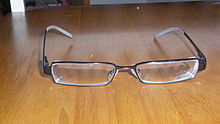
Glasses are ordinarily used to address near-sightedness.
The National Institutes of Health says there is no known mode of preventing myopia, and the use of spectacles or contact lenses does non affect its progression, unless the glasses or contact lenses are too strong of a prescription.[76] At that place is no universally accepted method of preventing myopia and proposed methods need additional report to determine their effectiveness.[46] Optical correction using glasses or contact lenses is the most mutual treatment; other approaches include orthokeratology, and refractive surgery.[46] : 21–26 Medications (mostly atropine) and vision therapy tin can exist effective in addressing the various forms of pseudomyopia.
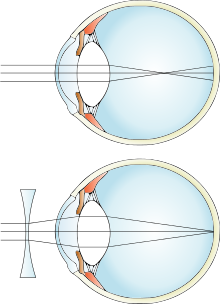
Compensating for myopia using a corrective lens.
Glasses and contacts [edit]


Prismatic color distortion shown with a camera set for almost-sighted focus, and using -nine.five-diopter eyeglasses to right the photographic camera's myopia (left). Close-up of colour shifting through corner of eyeglasses. The calorie-free and nighttime borders visible between colour swatches practise not exist (right).
Cosmetic lenses bend the light entering the heart in a way that places a focused prototype accurately onto the retina. The power of whatsoever lens arrangement can exist expressed in diopters, the reciprocal of its focal length in meters. Corrective lenses for myopia accept negative powers because a divergent lens is required to movement the far bespeak of focus out to the altitude. More astringent myopia needs lens powers further from zero (more negative). Still, strong eyeglass prescriptions create distortions such as prismatic movement and chromatic aberration. Strongly near-sighted wearers of contact lenses practise non experience these distortions because the lens moves with the cornea, keeping the optic axis in line with the visual centrality and because the vertex distance has been reduced to zero.
Surgery [edit]
Refractive surgery includes procedures which modify the corneal curvature of some structure of the eye or which add boosted refractive means inside the centre.
Photorefractive keratectomy [edit]
Photorefractive keratectomy (PRK) involves ablation of corneal tissue from the corneal surface using an excimer laser. The amount of tissue ablation corresponds to the amount of myopia. While PRK is a relatively safe procedure for up to 6 dioptres of myopia, the recovery stage mail service-surgery is usually painful.[77] [78]
LASIK [edit]
In a LASIK pre-procedure, a corneal flap is cut into the cornea and lifted to allow the excimer light amplification by stimulated emission of radiation beam access to the exposed corneal tissue. Later on that, the excimer laser ablates the tissue according to the required correction. When the flap again covers the cornea, the change in curvature generated by the laser ablation proceeds to the corneal surface. Though LASIK is unremarkably painless and involves a short rehabilitation period post-surgery, it can potentially effect in flap complications and loss of corneal stability (post-LASIK keratectasia).[79] [80]
Phakic intra-ocular lens [edit]
Instead of modifying the corneal surface, as in laser vision correction (LVC), this procedure involves implanting an additional lens inside the eye (i.e., in addition to the already existing natural lens). While it commonly results in good control of the refractive change, information technology can induce potential serious long-term complications such equally glaucoma, cataract and endothelial decompensation.[81] [82] [83]
Orthokeratology [edit]
Orthokeratology or but Ortho-K is a temporary corneal reshaping procedure using rigid gas permeable (RGP) contact lenses.[84] Overnight wearing of specially designed contact lenses volition temporarily reshape cornea, so patients may see conspicuously without any lenses in daytime. Orthokeratology can correct myopia up to -6D.[85] Several studies shown that Ortho-K can reduce myopia progression also.[86] [87] Risk factors of using Ortho-M lenses include microbial keratitis,[86] corneal edema,[88] etc. Other contact lens related complications like corneal aberration, photophobia, pain, irritation, redness etc. are usually temporary conditions, which may exist eliminated by proper usage of lenses.[88]
Intrastromal corneal ring segment [edit]
The Intrastromal corneal ring segment (ICRS), commonly used in keratoconus treatment now, was originally designed to correct mild to moderate myopia.[89] The thickness is directly related to flattening and the diameter of the band is proportionally inverse to the flattening of cornea. So, if diameter is smaller or thickness is greater, resulting myopia correction will exist greater.[xc]
Alternative medicine [edit]
A number of alternative therapies accept been claimed to improve myopia, including vision therapy, "behavioural optometry", various centre exercises and relaxation techniques, and the Bates method.[91] Scientific reviews have ended that there was "no clear scientific testify" that eye exercises are effective in treating almost-sightedness[92] and as such they "cannot be advocated".[93]
Epidemiology [edit]
Global refractive errors take been estimated to affect 800 meg to 2.iii billion.[94] The incidence of myopia inside sampled population oft varies with age, country, sex, race, ethnicity, occupation, environs, and other factors.[95] [96] Variability in testing and data drove methods makes comparisons of prevalence and progression difficult.[97]
The prevalence of myopia has been reported as high as 70–ninety% in some Asian countries, 30–40% in Europe and the United States, and ten–20% in Africa.[96] Myopia is about twice as mutual in Jewish people than in people of not-Jewish ethnicity.[98] Myopia is less mutual in African people and associated diaspora.[95] In Americans betwixt the ages of 12 and 54, myopia has been found to affect African Americans less than Caucasians.[99]
Asia [edit]

Estimated myopia rate in 20-year-olds in Asia.[100]
In some parts of Asia, myopia is very mutual.
- Singapore is believed to have the highest prevalence of myopia in the world; up to 80% of people there have myopia, but the accurate effigy is unknown.[101]
- Prc's myopia charge per unit is 31%: 400 million of its one.iii billion people are myopic. The prevalence of myopia in high school in China is 77%, and in college is more than eighty%.[102]
- In some areas, such as Red china and Malaysia, upward to 41% of the adult population is myopic to 1.00 dpt,[103] and upwards to 80% to 0.5 dpt.[104]
- A study of Jordanian adults aged 17 to 40 found over half (54%) were myopic.[105]
- Some research suggests the prevalence of myopia in Indian children is less than 15%.[106]
Europe [edit]

Myopia rate in Europe by nascency decade (1910 to 1970).[107]
- In first-year undergraduate students in the United Kingdom 50% of British whites and 53% of British Asians were myopic.[108]
- A contempo review found 27% of Western Europeans aged 40 or over have at to the lowest degree −1.00 diopters of myopia and five% have at least −5.00 diopters.[109]
Due north America [edit]
Myopia is mutual in the United States, with research suggesting this status has increased dramatically in recent decades. In 1971–1972, the National Health and Nutrition Test Survey provided the earliest nationally representative estimates for myopia prevalence in the U.S., and found the prevalence in persons aged 12–54 was 25%. Using the same method, in 1999–2004, myopia prevalence was estimated to take climbed to 42%.[110]
A study of two,523 children in grades 1 to viii (age, 5–17 years) institute nearly one in 10 (nine%) have at least −0.75 diopters of myopia.[111] In this study, 13% had at least +i.25 D hyperopia (farsightedness), and 28% had at least i.00-D divergence between the two primary meridians (cycloplegic autorefraction) of astigmatism. For myopia, Asians had the highest prevalence (19%), followed by Hispanics (13%). Caucasian children had the lowest prevalence of myopia (4%), which was not significantly different from African Americans (seven%).[111]
A recent review plant 25% of Americans aged 40 or over take at to the lowest degree −i.00 diopters of myopia and 5% have at least −5.00 diopters.[109]
Australia [edit]
In Australia, the overall prevalence of myopia (worse than −0.50 diopters) has been estimated to be 17%.[112] In one recent study, less than one in 10 (8%) Australian children between the ages of 4 and 12 were found to accept myopia greater than −0.50 diopters.[113] A recent review found sixteen% of Australians aged 40 or over have at least −1.00 diopters of myopia and three% have at to the lowest degree −five.00 diopters.[109]
Southward America [edit]
In Brazil, a 2005 study estimated vi% of Brazilians between the ages of 12 and 59 had −1.00 diopter of myopia or more, compared with iii% of the indigenous people in northwestern Brazil.[114] Another found most one in viii (xiii%) of the students in the city of Natal were myopic.[115]
History [edit]
The difference between the well-nigh-sighted and far-sighted people was noted already by Aristotle.[116] Graeco-Roman physician Galen first used the term "myopia" for near-sightedness.[116] The beginning spectacles for correcting myopia were invented by a German central in the yr 1451.[117] Johannes Kepler in his Description of Ophthalmic Dioptrics (1604) showtime demonstrated that near-sightedness was due to the incident light focusing in front of the retina. Kepler also showed that virtually-sightedness could be corrected by concave lenses.[116] In 1632, Vopiscus Fortunatus Plempius examined a myopic eye and confirmed that myopia was due to a lengthening of its axial diameter.[118]
Society and culture [edit]
The terms "myopia" and "myopic" (or the mutual terms "brusque-sightedness" or "short-sighted", respectively) have been used metaphorically to refer to cognitive thinking and decision making that is narrow in telescopic or lacking in foresight or in business organisation for wider interests or for longer-term consequences.[119] It is often used to depict a determination that may be benign in the nowadays, but detrimental in the future, or a viewpoint that fails to consider anything outside a very narrow and limited range. Hyperopia, the biological opposite of myopia, may also be used metaphorically for a value system or motivation that exhibits "farsighted" or mayhap visionary thinking and behavior; that is, emphasizing long-term interests at the apparent expense of about-term do good.[120]
Correlations [edit]
Numerous studies have constitute correlations between myopia, on the one hand, and intelligence and academic accomplishment, on the other;[121] it is non clear whether in that location is a causal human relationship.[122] Myopia is also correlated with increased microsaccade amplitude, suggesting that blurred vision from myopia might cause instability in fixational eye movements.[123] [124]
Etymology [edit]
The term myopia is of Koine Greek origin: μυωπία myōpia (or μυωπίασις myōpiasis ) "brusk-sight(-ness)", from Aboriginal Greek μύωψ myōps "curt-sighted (human being), (human) with eyes getting shut", from μύειν myein "to close the eyes" and ὤψ ōps "centre, look, sight" (GEN ὠπός ōpos ).[125] [126] [127] [128] [129] The reverse of myopia in English is hyperopia (long-sightedness).
Meet also [edit]
- Myopia in animals
- Myopic crescent
References [edit]
- ^ a b c d e f g h i j 1000 l m northward "Facts Almost Refractive Errors". NEI. Oct 2010. Archived from the original on 28 July 2016. Retrieved 30 July 2016.
- ^ a b c d e f g h i j thousand l Foster PJ, Jiang Y (Feb 2014). "Epidemiology of myopia". Eye. 28 (ii): 202–8. doi:10.1038/middle.2013.280. PMC3930282. PMID 24406412.
- ^ a b c d due east f Pan CW, Ramamurthy D, Saw SM (January 2012). "Worldwide prevalence and risk factors for myopia". Ophthalmic & Physiological Optics. 32 (1): iii–16. doi:ten.1111/j.1475-1313.2011.00884.x. PMID 22150586. S2CID 32397628.
- ^ a b Holden B, Sankaridurg P, Smith E, Aller T, Jong M, He M (February 2014). "Myopia, an underrated global challenge to vision: where the electric current information takes us on myopia command". Center. 28 (ii): 142–6. doi:10.1038/eye.2013.256. PMC3930268. PMID 24357836.
- ^ Ledford A, Nemeth SC, Ledford JK (2008). Ocular anatomy and physiology (2d ed.). Thorofare, NJ: SLACK. p. 158. ISBN9781556427923. Archived from the original on 8 September 2017.
- ^ a b Ramamurthy D, Lin Chua SY, Saw SM (November 2015). "A review of environmental hazard factors for myopia during early life, childhood and adolescence". Clinical & Experimental Optometry (Review). 98 (half dozen): 497–506. doi:x.1111/cxo.12346. PMID 26497977.
- ^ Xiong Southward, Sankaridurg P, Naduvilath T, Zang J, Zou H, Zhu J, et al. (September 2017). "Fourth dimension spent in outdoor activities in relation to myopia prevention and control: a meta-assay and systematic review". Acta Ophthalmologica. 95 (vi): 551–566. doi:10.1111/aos.13403. PMC5599950. PMID 28251836.
- ^ Hobday R (January 2016). "Myopia and daylight in schools: a neglected aspect of public health?". Perspectives in Public Health. 136 (1): 50–5. doi:x.1177/1757913915576679. PMID 25800796. S2CID 19400451.
- ^ a b c Pan CW, Dirani M, Cheng CY, Wong TY, Saw SM (March 2015). "The age-specific prevalence of myopia in Asia: a meta-assay". Optometry and Vision Science. 92 (three): 258–66. doi:10.1097/opx.0000000000000516. PMID 25611765. S2CID 42359341.
- ^ Dong L, Kang YK, Li Y, Wei WB, Jonas JB (March 2020). "Prevalence And Time Trends Of Myopia In Children And Adolescents In Prc: A Systemic Review and Meta-Analysis". Retina (Philadelphia, Pa.). twoscore (3): 399–411. doi:10.1097/IAE.0000000000002590. PMID 31259808. S2CID 195756787.
- ^ a b c d Coviltir V, Burcel M, Cherecheanu AP, Ionescu C, Dascalescu D, Potop V, Burcea M (2019). "Update on Myopia Gamble Factors and Microenvironmental Changes". Journal of Ophthalmology. 2019: 4960852. doi:10.1155/2019/4960852. PMC6875023. PMID 31781378.
- ^ Huang HM, Chang DS, Wu PC (2015). "The Association between Near Work Activities and Myopia in Children-A Systematic Review and Meta-Analysis". PLOS ONE. 10 (x): e0140419. Bibcode:2015PLoSO..1040419H. doi:10.1371/journal.pone.0140419. PMC4618477. PMID 26485393.
- ^ a b Shapira Y, Mimouni Thou, Machluf Y, Chaiter Y, Saab H, Mezer Due east (December 2019). "The Increasing Burden of Myopia in Israel among Immature Adults over a Generation: Analysis of Predisposing Factors". Ophthalmology. 126 (12): 1617–1626. doi:10.1016/j.ophtha.2019.06.025. PMID 31474440. S2CID 198380872.
- ^ Sivak J (November 2012). "The cause(s) of myopia and the efforts that have been made to forbid it". Clinical & Experimental Optometry. 95 (6): 572–82. doi:10.1111/j.1444-0938.2012.00781.x. PMID 22845416.
- ^ a b Dolgin E (March 2015). "The myopia boom". Nature. 519 (7543): 276–8. Bibcode:2015Natur.519..276D. doi:10.1038/519276a. PMID 25788077.
- ^ Medina A (June 2021). "The cause of myopia evolution and progression: Theory, prove, and handling". Survey of Ophthalmology. doi:10.1016/j.survophthal.2021.06.005. PMID 34181975.
- ^ "Myopia (Nearsightedness)". world wide web.aoa.org . Retrieved 25 December 2019.
- ^ Jacobi FK, Pusch CM (January 2010). "A decade in search of myopia genes". Frontiers in Bioscience. fifteen: 359–72. doi:x.2741/3625. PMID 20036825.
- ^ Verhoeven VJ, Hysi PG, Wojciechowski R, Fan Q, Guggenheim JA, Höhn R, et al. (March 2013). "Genome-wide meta-analyses of multiancestry cohorts identify multiple new susceptibility loci for refractive error and myopia". Nature Genetics. 45 (3): 314–8. doi:10.1038/ng.2554. PMC3740568. PMID 23396134.
- ^ Neitz M, Neitz J (Baronial 2021). "Intermixing the OPN1LW and OPN1MW Genes Disrupts the Exonic Splicing Code Causing an Array of Vision Disorders". Genes. 12 (8): 1180. doi:10.3390/genes12081180. PMC8391646. PMID 34440353.
- ^ Li J, Gao B, Guan Fifty, Xiao X, Zhang J, Li S, et al. (June 2015). "Unique Variants in OPN1LW Cause Both Syndromic and Nonsyndromic X-Linked High Myopia Mapped to MYP1". Investigative Ophthalmology & Visual Science. 56 (6): 4150–4155. doi:10.1167/iovs.14-16356. PMID 26114493.
- ^ Dirani M, Chamberlain 1000, Shekar SN, Islam AF, Garoufalis P, Chen CY, et al. (Nov 2006). "Heritability of refractive mistake and ocular biometrics: the Genes in Myopia (Gem) twin study". Investigative Ophthalmology & Visual Science. 47 (11): 4756–61. doi:10.1167/iovs.06-0270. PMID 17065484.
- ^ Lopes MC, Andrew T, Carbonaro F, Spector TD, Hammond CJ (January 2009). "Estimating heritability and shared environmental effects for refractive mistake in twin and family studies". Investigative Ophthalmology & Visual Science. 50 (one): 126–31. doi:10.1167/iovs.08-2385. PMID 18757506.
- ^ Peet JA, Cotch MF, Wojciechowski R, Bailey-Wilson JE, Stambolian D (September 2007). "Heritability and familial aggregation of refractive error in the Erstwhile Order Amish". Investigative Ophthalmology & Visual Scientific discipline. 48 (ix): 4002–6. doi:10.1167/iovs.06-1388. PMC1995233. PMID 17724179.
- ^ Tkatchenko AV, Tkatchenko Tv, Guggenheim JA, Verhoeven VJ, Hysi PG, Wojciechowski R, et al. (August 2015). "APLP2 Regulates Refractive Mistake and Myopia Development in Mice and Humans". PLOS Genetics. eleven (8): e1005432. doi:10.1371/journal.pgen.1005432. PMC4551475. PMID 26313004.
- ^ Gusev A, Bhatia Chiliad, Zaitlen N, Vilhjalmsson BJ, Diogo D, Stahl EA, et al. (2013). "Quantifying missing heritability at known GWAS loci". PLOS Genetics. 9 (12): e1003993. doi:x.1371/journal.pgen.1003993. PMC3873246. PMID 24385918.
- ^ a b c Lieberman, Daniel E. (2013) The Story of the Human Body: Evolution, Wellness, and Disease. New York: Pantheon Books.[ page needed ]
- ^ Sherwin J (25 October 2011). "Lack of outdoor play linked to short-sighted children". BBC News. Archived from the original on 25 Oct 2011. Retrieved 25 October 2011.
- ^ Dirani M, Tong L, Gazzard Thou, Zhang Ten, Chia A, Young TL, et al. (August 2009). "Outdoor activity and myopia in Singapore teenage children". The British Journal of Ophthalmology. 93 (8): 997–1000. doi:10.1136/bjo.2008.150979. PMID 19211608. S2CID 30301026.
- ^ Rose KA, Morgan IG, Ip J, Kifley A, Huynh S, Smith W, Mitchell P (Baronial 2008). "Outdoor activity reduces the prevalence of myopia in children". Ophthalmology. 115 (8): 1279–85. doi:ten.1016/j.ophtha.2007.12.019. PMID 18294691.
- ^ Dolgin E (March 2015). "The myopia boom". Nature. 519 (7543): 276–8. Bibcode:2015Natur.519..276D. doi:10.1038/519276a. PMID 25788077.
- ^ Cui D, Trier Thousand, Munk Ribel-Madsen South (May 2013). "Effect of mean solar day length on eye growth, myopia progression, and change of corneal ability in myopic children". Ophthalmology. 120 (v): 1074–9. doi:ten.1016/j.ophtha.2012.10.022. PMID 23380471.
- ^ Feldkaemper One thousand, Schaeffel F (September 2013). "An updated view on the function of dopamine in myopia". Experimental Eye Research (review). 114: 106–xix. doi:x.1016/j.exer.2013.02.007. PMID 23434455.
- ^ Nickla DL (September 2013). "Ocular diurnal rhythms and eye growth regulation: where we are fifty years afterwards Lauber". Experimental Eye Research (Review). 114: 25–34. doi:10.1016/j.exer.2012.12.013. PMC3742730. PMID 23298452.
- ^ Nickla, Debora L.; Jordan, Kelsey; Yang, Jane; Totonelly, Kristen (1 Baronial 2017). "Cursory hyperopic defocus or course deprivation have varying effects on eye growth and ocular rhythms depending on the time-of-day of exposure". Experimental Eye Inquiry. 161: 132–142. doi:ten.1016/j.exer.2017.06.003. PMC5557081. PMID 28596085.
- ^ "Overminus Lenses Associated with Myopia Progression".
- ^ a b https://www.optometrystudents.com/pearl/over-minus-you-probably-do-itstop-it/[ unreliable medical source? ] [ full citation needed ]
- ^ a b Borish, Irvin M. (1949). Clinical Refraction. Chicago: The Professional Printing.
- ^ a b Knuckles-Elderberry, Sir Stewart (1969). The Practice of Refraction (8th ed.). St. Louis: The C.V. Mosby Company. ISBN 0-7000-1410-1.
- ^ a b c d e f g h i j Cline D, Hofstetter HW, Griffin JR (1997). Lexicon of Visual Science (4th ed.). Boston: Butterworth-Heinemann. ISBN978-0-7506-9895-5.
- ^ Summanen P, Kivitie-Kallio S, Norio R, Raitta C, Kivelä T (May 2002). "Mechanisms of myopia in Cohen syndrome mapped to chromosome 8q22". Investigative Ophthalmology & Visual Scientific discipline. 43 (5): 1686–93. PMID 11980891.
- ^ The Eyecare Trust. Night Driving – The Facts. OR Eye intendance communication for driving in the dark Archived 20 March 2012 at the Wayback Machine 26 Jan 2005.'
- ^ a b Panday VA, Rhee DJ (September 2007). "Review of sulfonamide-induced acute myopia and acute bilateral angle-closure glaucoma". Comprehensive Ophthalmology Update (Review). eight (5): 271–six. PMID 18201514.
- ^ Goss DA, Eskridge JB (1988). "Myopia". In Amos JB (ed.). Diagnosis and direction in vision care. Boston: Butterworths. p. 445. ISBN978-0-409-95082-three. OCLC 14967262.
- ^ a b Richards OW (October 1976). "Musical instrument myopia--microscopy". American Journal of Optometry and Physiological Eyes. 53 (10): 658–63. doi:x.1097/00006324-197610000-00003. PMID 1015520. S2CID 37513722.
- ^ a b c d e f g h i j American Optometric Association (1997). Optometric Clinical Practice Guideline: Care of the Patient with Myopia (PDF) (Study). Archived from the original (PDF) on 22 January 2015. Retrieved 17 February 2015.
- ^ Li CY, Lin KK, Lin YC, Lee JS (March 2002). "Low vision and methods of rehabilitation: a comparison betwixt the by and present". Chang Gung Medical Periodical. 25 (3): 153–61. PMID 12022735.
- ^ Cassin, B. and Solomon, Southward. (2001) Dictionary of Eye Terminology. Gainesville, Florida: Triad Publishing Company. ISBN 0937404632.
- ^ Ong E, Ciuffreda KJ (1995). "Nearwork-induced transient myopia: a critical review". Documenta Ophthalmologica. Advances in Ophthalmology. 91 (ane): 57–85. doi:10.1007/BF01204624. PMID 8861637. S2CID 2065074.
- ^ Ciuffreda KJ, Vasudevan B (March 2008). "Nearwork-induced transient myopia (NITM) and permanent myopia--is at that place a link?". Ophthalmic & Physiological Optics. 28 (2): 103–xiv. doi:10.1111/j.1475-1313.2008.00550.x. PMID 18339041. S2CID 28700508.
- ^ Vukojević, Nenad; Šikić, Jakov; Ćurković, Tihomir; Juratovac, Zlatko; Katušić, Damir; Šarić, Borna; Jukić, Tomislav (xx June 2005). "Axial Eye Length afterward Retinal Disengagement Surgery". Collegium Antropologicum. 29 - Supplement i (1): 25–27. PMID 16193671.
- ^ Metge P, Donnadieu M (September 1993). "Myopie et cataracte" [Myopia and cataract]. La Revue du Praticien (in French). 43 (14): 1784–six. OCLC 116851621. PMID 8310218.
- ^ Young FA (February 1962). "The effect of nearwork illumination level on monkey refraction". American Journal of Optometry & Archives of American University of Optometry. 39 (two): 60–7. doi:10.1097/00006324-196202000-00002. PMID 14009334.
- ^ Zhu X, Park TW, Winawer J, Wallman J (July 2005). "In a affair of minutes, the eye can know which way to abound". Investigative Ophthalmology & Visual Science. 46 (seven): 2238–41. doi:10.1167/iovs.04-0956. PMID 15980206.
- ^ Wallman J, Gottlieb MD, Rajaram Five, Fugate-Wentzek LA (July 1987). "Local retinal regions control local eye growth and myopia". Science. 237 (4810): 73–7. Bibcode:1987Sci...237...73W. doi:10.1126/scientific discipline.3603011. JSTOR 1699607. PMID 3603011. S2CID 31790023.
- ^ Shen W, Vijayan 1000, Sivak JG (May 2005). "Inducing form-deprivation myopia in fish". Investigative Ophthalmology & Visual Science. 46 (5): 1797–803. doi:10.1167/iovs.04-1318. PMID 15851585.
- ^ a b Grosvenor T (July 1987). "A review and a suggested nomenclature system for myopia on the basis of age-related prevalence and age of onset". American Journal of Optometry and Physiological Optics. 64 (vii): 545–54. doi:10.1097/00006324-198707000-00012. PMID 3307441.
- ^ "Glaucoma." Archived xix August 2006 at the Wayback Machine EyeMDLink.com. Retrieved 27 Baronial 2006.
- ^ Zejmo, Maria; Formińska-Kapuścik, Maria; Pieczara, Ewa; Filipek, Erita; Mrukwa-Kominek, Ewa; Samochowiec-Donocik, Elzbieta; Leszczyński, Rafal; Smuzyńska, Magdalena (September 2009). "Etiopathogenesis and management of loftier-degree myopia. Part I". Medical Science Monitor. 15 (9): RA199-202. PMID 19721411. INIST:21992936.
- ^ Retinal Detachment at eMedicine
- ^ "More Information on Glaucoma." AgingEye Times. Retrieved 27 Baronial 2006.
- ^ Messmer DE (May 1992). "[Retinal disengagement]". Schweizerische Rundschau für Medizin Praxis = Revue Suisse de Médecine Praxis (in German). 81 (19): 622–5. PMID 1589678.
- ^ Banerjee Due south, Horton J. Lenses and Spectacles to Forestall Myopia Worsening in Children [Internet]. Ottawa (ON): Canadian Agency for Drugs and Technologies in Wellness; 2021 Apr. Available from: https://www.ncbi.nlm.nih.gov/books/NBK571917/
- ^ Walline JJ, Walker MK, Mutti DO, et al. Effect of High Add Ability, Medium Add together Ability, or Single-Vision Contact Lenses on Myopia Progression in Children: The Glimmer Randomized Clinical Trial. JAMA. 2020;324(6):571-580.
- ^ Ruiz-Pomeda A, Perez-Sanchez B, Valls I, Prieto-Garrido FL, Gutierrez-Ortega R, Villa-Collar C. MiSight Assessment Study Spain (MASS). A two-year randomized clinical trial. Graefes Arch Clin Exp Ophthalmol. 2018;256(v):1011-1021.
- ^ Garcia-Del Valle AM, Blazquez 5, Gros-Otero J, et al. Efficacy and safety of a soft contact lens to command myopia progression. Clin Exp Optom. 2021;104(1):14-21
- ^ Morgan I, Rose K (January 2005). "How genetic is school myopia?". Progress in Retinal and Eye Inquiry. 24 (1): one–38. doi:ten.1016/j.preteyeres.2004.06.004. PMID 15555525. S2CID 18045281.
- ^ a b Saw SM, Gazzard Grand, Au Eong KG, Tan DT (November 2002). "Myopia: attempts to abort progression". The British Journal of Ophthalmology. 86 (11): 1306–1311. doi:10.1136/bjo.86.11.1306. PMC1771373. PMID 12386095.
- ^ Leshno A, Farzavandi SK, Gomez-de-Liaño R, Sprunger DT, Wygnanski-Jaffe T, Mezer E (April 2020). "Do patterns to subtract myopia progression differ among paediatric ophthalmologists around the world". The British Journal of Ophthalmology. 104 (iv): 535–540. doi:10.1136/bjophthalmol-2019-314752. hdl:1805/23932. PMID 31409647. S2CID 199573510.
- ^ Ong Due east, Grice Thousand, Held R, Thorn F, Gwiazda J (June 1999). "Furnishings of spectacle intervention on the progression of myopia in children". Optometry and Vision Scientific discipline. 76 (6): 363–9. doi:10.1097/00006324-199906000-00015. PMID 10416930.
- ^
- ^ Office of the Commissioner (15 Nov 2019). "FDA approves get-go contact lens indicated to dull the progression of nearsightedness in children". FDA . Retrieved xviii November 2019.
- ^ a b Walline JJ, Lindsley KB, Vedula SS, Cotter SA, Mutti Do, Ng SM, Twelker JD (2020). "Interventions to slow progression of myopia in children". The Cochrane Database of Systematic Reviews. 1 (ane): CD0O6460. doi:10.1002/14651858.CD004916.pub4. PMC6984636. PMID 31930781.
- ^ Smith MJ, Walline JJ (2015). "Controlling myopia progression in children and adolescents". Boyish Health, Medicine and Therapeutics. 6: 133–40. doi:10.2147/AHMT.S55834. PMC4542412. PMID 26316834.
- ^ Ward B, Tarutta EP, Mayer MJ (December 2009). "The efficacy and safety of posterior pole buckles in the command of progressive loftier myopia". Eye. 23 (12): 2169–74. doi:x.1038/centre.2008.433. PMID 19229272.
- ^ Near-sightedness Archived 10 May 2016 at the Wayback Auto. National Institutes of Health. 2010.
- ^ Trokel SL, Srinivasan R, Braren B (December 1983). "Excimer laser surgery of the cornea". American Journal of Ophthalmology. 96 (6): 710–5. doi:x.1016/s0002-9394(fourteen)71911-vii. PMID 6660257.
- ^ Seiler T, Bende T, Wollensak J, Trokel South (Feb 1988). "Excimer laser keratectomy for correction of astigmatism". American Journal of Ophthalmology. 105 (2): 117–24. doi:10.1016/0002-9394(88)90173-0. PMID 3341427.
- ^ Pallikaris IG, Siganos DS (1997). "Laser in situ keratomileusis to treat myopia: early experience". Journal of Cataract and Refractive Surgery. 23 (1): 39–49. doi:10.1016/s0886-3350(97)80149-6. PMID 9100106. S2CID 38655546.
- ^ Pallikaris IG, Kymionis GD, Astyrakakis NI (November 2001). "Corneal ectasia induced by light amplification by stimulated emission of radiation in situ keratomileusis". Periodical of Cataract and Refractive Surgery. 27 (11): 1796–802. doi:x.1016/s0886-3350(01)01090-2. PMID 11709254. S2CID 2333450.
- ^ Menezo JL, Peris-Martínez C, Cisneros-Lanuza AL, Martínez-Costa R (2004). "Rate of cataract formation in 343 highly myopic eyes after implantation of three types of phakic intraocular lenses". Periodical of Refractive Surgery. 20 (4): 317–24. doi:10.3928/1081-597X-20040701-03. PMID 15307392.
- ^ Torun N, Bertelmann E, Klamann MK, Maier AK, Liekfeld A, Gonnermann J (July 2013). "Posterior chamber phakic intraocular lens to correct myopia: long-term follow-up". Journal of Cataract and Refractive Surgery. 39 (vii): 1023–8. doi:ten.1016/j.jcrs.2013.01.041. PMID 23664355. S2CID 31750663.
- ^ Moshirfar M, Imbornoni LM, Ostler EM, Muthappan V (2014). "Incidence rate and occurrence of visually significant cataract formation and corneal decompensation after implantation of Verisyse/Artisan phakic intraocular lens". Clinical Ophthalmology. eight: 711–half dozen. doi:x.2147/OPTH.S59878. PMC3986296. PMID 24748765.
- ^ "Orthokeratology (Ortho-1000) - Corneal Reshaping with GP Contacts". www.contactlenses.org.
- ^ "Orthokeratology: A Heated Contend Continues". www.ophthalmologyweb.com.
- ^ a b "Orthokeratology slows myopic progression in immature patients". American Academy of Ophthalmology. 17 Apr 2019.
- ^ "Orthokeratology (Ortho-K) handling for Myopia Prevention and Control". world wide web.myopiaprevention.org. Archived from the original on 6 February 2020. Retrieved 4 June 2020.
- ^ a b Daniels M. "Consider Ortho-K For Myopia Command". www.reviewofoptometry.com.
- ^ Vega-Estrada A, Alio JL (15 March 2016). "The use of intracorneal ring segments in keratoconus". Heart and Vision. iii: 8. doi:ten.1186/s40662-016-0040-z. PMC4791885. PMID 26981548.
- ^ Pathak AK, Villarreal Gonzalez AJ, Karacal H. "ICRS: Corneal biomechanics effects".
- ^ Bates, Wm H (1920) Sight Without Spectacles Archived 20 Dec 2016 at the Wayback Machine. Ch. 10, p. 106. ISBN 1479118540.
- ^ Rawstron JA, Burley CD, Elder MJ (2005). "A systematic review of the applicability and efficacy of eye exercises". Periodical of Pediatric Ophthalmology and Strabismus. 42 (2): 82–8. doi:x.3928/01913913-20050301-02. PMID 15825744.
- ^ Barrett BT (January 2009). "A critical evaluation of the evidence supporting the exercise of behavioural vision therapy". Ophthalmic & Physiological Optics. 29 (i): four–25. doi:x.1111/j.1475-1313.2008.00607.x. PMID 19154276. S2CID 13588501.
- ^ Dunaway D, Berger I. "Worldwide Distribution of Visual Refractive Errors and What to Expect at a Particular Location" Archived 29 January 2007 at the Wayback Car. infocusonline.org.
- ^ a b Phakic Intraocular Lens (IOL) for Myopia Correction at eMedicine
- ^ a b Fredrick DR (May 2002). "Myopia". BMJ. 324 (7347): 1195–ix. doi:x.1136/bmj.324.7347.1195. PMC1123161. PMID 12016188.
- ^ National Research Council Committee (1989). Myopia: Prevalence and Progression Archived 6 January 2014 at the Wayback Machine, Washington, D.C. : National Academy Press, ISBN 0-309-04081-7
- ^ Jensen, A.R. (1998) The chiliad Factor. Westport, Connecticut: Praeger Publishers, ISBN 0275961036
- ^ Sperduto RD, Seigel D, Roberts J, Rowland M (March 1983). "Prevalence of myopia in the United states of america". Archives of Ophthalmology. 101 (3): 405–7. doi:10.1001/archopht.1983.01040010405011. PMID 6830491.
- ^ Morgan IG, French AN, Ashby RS, Guo X, Ding X, He M, Rose KA (January 2018). "The epidemics of myopia: Aetiology and prevention". Progress in Retinal and Heart Research. 62: 134–149. doi:ten.1016/j.preteyeres.2017.09.004. hdl:1885/139488. PMID 28951126. S2CID 9323449.
- ^ "Discovery of Gene May Provide Handling for Near-sightedness". Disabled-world.com. 12 September 2010. Retrieved 2 August 2012. [ permanent dead link ]
- ^ 全国近视眼人数近4亿 近视已影响国人健康 Archived 27 October 2012 at the Wayback Car. Xinhua News Bureau. Retrieved on 21 April 2013.
- ^ Chandran S (June 1972). "Comparative study of refractive errors in Westward Malaysia". The British Journal of Ophthalmology. 56 (6): 492–5. doi:ten.1136/bjo.56.6.492. PMC1208824. PMID 5069190.
- ^ Wu HM, Seet B, Yap EP, Saw SM, Lim Thursday, Chia KS (April 2001). "Does pedagogy explain ethnic differences in myopia prevalence? A population-based study of young adult males in Singapore". Optometry and Vision Science. 78 (four): 234–9. doi:10.1097/00006324-200104000-00012. PMID 11349931. S2CID 46445087.
- ^ Mallen EA, Gammoh Y, Al-Bdour M, Sayegh FN (July 2005). "Refractive error and ocular biometry in Jordanian adults". Ophthalmic & Physiological Eyes. 25 (iv): 302–9. doi:10.1111/j.1475-1313.2005.00306.10. PMID 15953114. S2CID 24694696.
- ^ Saxena R, Vashist P, Tandon R, Pandey RM, Bhardawaj A, Gupta V, Menon V (2017). "Incidence and progression of myopia and associated factors in urban school children in Delhi: The North India Myopia Study (NIM Study)". PLOS ONE. 12 (12): e0189774. Bibcode:2017PLoSO..1289774S. doi:10.1371/journal.pone.0189774. PMC5734754. PMID 29253002.
- ^ Williams KM, Bertelsen G, Cumberland P, Wolfram C, Verhoeven VJ, Anastasopoulos Due east, et al. (July 2015). "Increasing Prevalence of Myopia in Europe and the Touch of Pedagogy". Ophthalmology. 122 (7): 1489–97. doi:x.1016/j.ophtha.2015.03.018. PMC4504030. PMID 25983215.
- ^ Logan NS, Davies LN, Mallen EA, Gilmartin B (April 2005). "Ametropia and ocular biometry in a U.G. university pupil population". Optometry and Vision Scientific discipline. 82 (4): 261–6. doi:10.1097/01.OPX.0000159358.71125.95. PMID 15829853. S2CID 25384178.
- ^ a b c Kempen JH, Mitchell P, Lee KE, Tielsch JM, Broman AT, Taylor HR, et al. (April 2004). "The prevalence of refractive errors among adults in the United States, Western Europe, and Australia". Archives of Ophthalmology. 122 (4): 495–505. doi:10.1001/archopht.122.4.495. PMID 15078666.
- ^ Vitale South, Sperduto RD, Ferris FL (Dec 2009). "Increased prevalence of myopia in the United States between 1971-1972 and 1999-2004". Athenaeum of Ophthalmology. 127 (12): 1632–9. doi:10.1001/archophthalmol.2009.303. PMID 20008719.
- ^ a b Kleinstein RN, Jones LA, Hullett Southward, Kwon S, Lee RJ, Friedman NE, et al. (August 2003). "Refractive error and ethnicity in children". Athenaeum of Ophthalmology. 121 (viii): 1141–7. doi:10.1001/archopht.121.8.1141. PMID 12912692.
- ^ Wensor M, McCarty CA, Taylor HR (May 1999). "Prevalence and risk factors of myopia in Victoria, Australia". Archives of Ophthalmology. 117 (5): 658–63. doi:x.1001/archopht.117.5.658. PMID 10326965.
- ^ Junghans BM, Crewther SG (February 2005). "Trivial prove for an epidemic of myopia in Australian primary school children over the last thirty years". BMC Ophthalmology. 5: 1. doi:10.1186/1471-2415-5-1. PMC552307. PMID 15705207.
- ^ Thorn F, Cruz AA, Machado AJ, Carvalho RA (April 2005). "Refractive status of ethnic people in the northwestern Amazon region of Brazil". Optometry and Vision Science. 82 (4): 267–72. doi:10.1097/01.OPX.0000159371.25986.67. PMID 15829854. S2CID 38979284.
- ^ Garcia CA, Oréfice F, Nobre GF, Souza D, Rocha ML, Vianna RN (June 2005). "[Prevalence of refractive errors in students in Northeastern Brazil]". Arquivos Brasileiros de Oftalmologia. 68 (three): 321–5. doi:x.1590/S0004-27492005000300009. PMID 16059562.
- ^ a b c Spaide RF, Ohno-Matsui KM, Yannuzzi LA, eds. (2013). Pathologic Myopia. Springer Science & Business Media. p. two. ISBN978-1461483380.
- ^ "Myopia - Birth Story". Archived from the original on twenty April 2016. Retrieved i June 2020.
- ^ Dunphy EB (Oct 1970). "The biological science of myopia". The New England Journal of Medicine. 283 (15): 796–800. doi:x.1056/NEJM197010082831507. PMID 4917270.
- ^ Brooks, David (19 March 2009). Perverse Cosmic Myopia Archived 7 November 2015 at the Wayback Machine. New York Times.
- ^ Thompson C (17 September 2009). "Don't Work All the Time". Wired. Vol. 17, no. 8. Archived from the original on 17 August 2009. Retrieved 14 August 2009.
- ^ Williams KM, Hysi PG, Yonova-Doing E, Mahroo OA, Snieder H, Hammond CJ (April 2017). "Phenotypic and genotypic correlation betwixt myopia and intelligence". Scientific Reports. 7 (ane): 45977. Bibcode:2017NatSR...745977W. doi:ten.1038/srep45977. PMC5382686. PMID 28383074.
- ^ Verma A, Verma A (2015). "A novel review of the prove linking myopia and high intelligence". Journal of Ophthalmology. 2015: 271746. doi:ten.1155/2015/271746. PMC4306218. PMID 25653868.
- ^ Ghasia FF, Shaikh AG (April 2015). "Uncorrected Myopic Refractive Error Increases Microsaccade Amplitude". Investigative Ophthalmology & Visual Scientific discipline. 56 (four): 2531–five. doi:10.1167/iovs.xiv-15882. PMID 25678690.
- ^ Alexander RG, Macknik SL, Martinez-Conde S (2018). "Microsaccade Characteristics in Neurological and Ophthalmic Disease". Frontiers in Neurology. nine: 144. doi:x.3389/fneur.2018.00144. PMC5859063. PMID 29593642.
- ^ μυωπία , μυωπίασις , μύωψ , μύειν , ὤψ . Liddell, Henry George; Scott, Robert; A Greek–English Lexicon at the Perseus Projection.
- ^ Robert B (2010). Etymological Dictionary of Greek. Leiden Indo-European Etymological Dictionary Series. Vol. 2. With the assistance of Lucien van Beek. Leiden, Boston: Brill. pp. 988–9. ISBN9789004174184.
- ^ "μυωπία". Dictionary of Standard Modernistic Greek. Institute for Modern Greek Studies of the Artistotle University of Thessaloniki (in Greek). Retrieved 19 Feb 2016.
- ^ "myopia". Oxford English Dictionary (2d ed.). Oxford University Press. 1989.
- ^ Harper, Douglas. "myopia". Online Etymology Dictionary.
External links [edit]
davisaccamented01.blogspot.com
Source: https://en.wikipedia.org/wiki/Myopia
0 Response to "Family Eye Care, Conekin Iii George M Od"
Post a Comment